

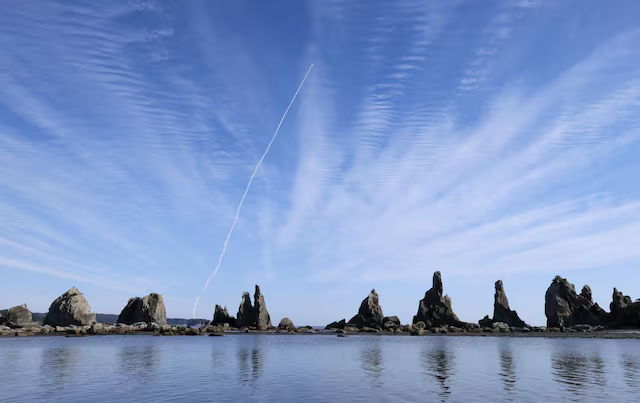

Space One said its Kairos rocket terminated its flight shortly after lift-off on Thursday, marking the company’s third consecutive failure and leaving Japan without a fully operational commercial satellite launch capability.
The 18-metre solid-propellant Kairos rocket was carrying five experimental satellites, including payloads from Tokyo-based ArkEdge Space and the Taiwan Space Agency. The company said it made the decision to end the mission after determining that achieving its objectives had become unlikely.
Live broadcast footage showed the rocket veering onto a wobbly trajectory within two minutes of launch from Space One’s private launch facility on the Kii Peninsula in western Japan.
The latest setback complicates Japan’s efforts to build a domestic launch industry and reduce dependence on foreign providers at a time of rising space-security concerns, particularly in response to China’s growing capabilities.
Space One, a joint venture backed by Canon, IHI and other major Japanese firms, had previously attempted two Kairos launches in 2024. Neither mission successfully deployed its payload.
The company said it is investigating the cause of the failure and plans to hold a press conference later Thursday.
Japan has struggled to maintain a steady pipeline of domestically developed rockets despite increasing defence and commercial demand. According to government data, the country successfully launched just three rockets in 2025, trailing the United States, China, Russia, France and India.
Tokyo aims to increase its annual launch frequency to 30 by the early 2030s. However, a separate setback in December involving the state-backed H3 rocket built by Mitsubishi Heavy Industries further disrupted plans.
As a result, Japanese satellite firms have increasingly turned to U.S.-based providers such as SpaceX and Rocket Lab for reliable and cost-effective launch services.
To address the bottleneck, the Japanese government has provided subsidies to emerging private rocket developers, including Space One and other startups. The defence ministry has also awarded contracts to build a constellation of national security satellites.
Meanwhile, major Japanese manufacturers are investing in space technology to reduce reliance on foreign launch systems and adapt industrial capabilities amid the global shift toward electrification. Toyota last year invested in Interstellar Technologies, while Honda conducted a surprise experiment involving a reusable launch vehicle.
Despite these efforts, no Japanese private rocket company has yet achieved a successful commercial satellite deployment — underscoring the scale of the challenge facing the country’s emerging space industry.