

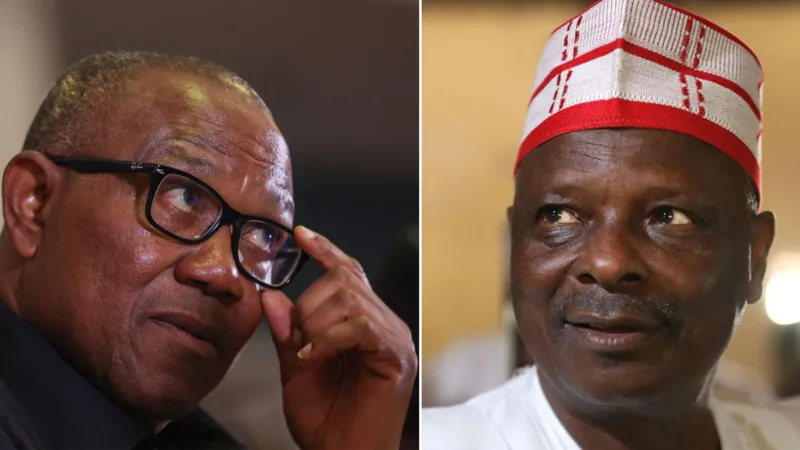

Nigeria’s political landscape has been thrown into flux after two leading opposition figures, Peter Obi and Rabiu Kwankwaso, announced their defection to a new party ahead of next year’s presidential election.
The pair, who finished third and fourth respectively in the 2023 election, have joined the Nigeria Democratic Congress (NDC), sparking speculation about a possible joint ticket to challenge President Bola Tinubu.
Both Obi and Kwankwaso were previously members of the African Democratic Congress (ADC), alongside former Vice-President Atiku Abubakar, who came second in the last election. However, the alliance within the ADC has been plagued by internal disputes and legal battles over party leadership.
Speaking after his defection, Obi accused state actors of interfering in opposition politics. “The same Nigerian state and its agents that created unnecessary crises… now appear to be finding their way into the ADC,” he said. He previously contested the 2023 election under the Labour Party.
The two politicians were formally welcomed at the NDC headquarters in Abuja by party leader Seriake Dickson. Both called for unity, youth empowerment, and an end to divisions within the opposition.
Obi remains highly popular among younger voters in southern Nigeria, while Kwankwaso holds significant influence in the north, making their alliance potentially formidable. Political analysts suggest a joint ticket could pose a serious challenge to the ruling All Progressives Congress (APC).
However, the move risks deepening divisions within the opposition. Some figures within the ADC-led coalition have reportedly expressed frustration, raising concerns about whether a united front against Tinubu can be maintained.
The presidency downplayed the defections, calling them part of the “normal fluidity of democratic politics.” A spokesperson said the government remains focused on economic reforms, security, and national stability.
Tinubu, 74, is widely expected to seek a second term, although he has yet to formally announce his candidacy. Supporters have already paid the required nomination fee for the APC primaries.
Analysts say the latest developments could significantly reshape the electoral race. “If the NDC fields Obi as president and Kwankwaso as vice-president, they will give the ruling party a strong challenge,” one observer noted.
Uncertainty remains over who will lead the new alliance, an issue that has historically fractured Nigerian opposition coalitions. Meanwhile, legal disputes within the ADC continue, with a recent Supreme Court ruling sending the party’s leadership case back to a lower court—further complicating preparations for the upcoming vote.
Nigeria is scheduled to hold its next general election in early January, marking the country’s eighth since the return to civilian rule in 1999.